Incorrect tonnage on a press brake can either mean that you are wasting capacity by using more than you need to, or even putting excessive strain on the machine and tools. Simple checks before forming can establish the force actually required to form the bend.
Start With Yield Strength, Not Thickness
Tonnage is often set based upon the thickness of the material being bent, but thickness of material does not equal bulk of material. Two identical thicknesses of material can require totally different amounts of force to bend depending upon their yield strength. A good reference to how a material’s yield strength affects the forming force can be found on the IET web site. In essence strength not thickness is what the press is trying to force.
Mild Steel as a Baseline
The material which most tonnage charts are based upon is mild steel. A rough rule of thumb for mild steel is 1mm thick material would require around 5-10 tonnes per meter of bend length and 6mm thick material 40+ tonnes per meter of bend length. The tonnage required for mild steel can vary depending upon the die opening and bend type but this gives an initial reference point. A calculated tonnage of 100tonnes/m for 2mm mild steel suggests some error with the input data.
Stainless Needs More Force Than You’d Expect
Stainless steel can need 30% to 50% more force than mild steel of the same thickness. The higher yield strength of the material is a big part of this, as well as the work-hardening that occurs as the material is bent. This means that the material will get harder as it is bent, so the force required to complete the bend can rise significantly part way through the stroke. Therefore, operators used to bending mild steel can easily under-tonnage stainless steel parts and then be confused as to why the bends do not close as expected or the material springs back excessively.
Aluminium Usually Needs Less, But Watch Cracking
For aluminium materials, typically a lower force is required than for equivalent steel thicknesses. This is due in part to the lower yield strength of the material, but also work hardening during the bend. However, note that very tight bend radii can easily crack the surface of the material, even when adequate force is applied. In fact, it is easy to crack the outer surface of very hard aluminium tempers when using tight bend radii even at correct force. Hairline cracks in bends can often go unnoticed until some time later. See also Cotswold Machinery Bending Machines.
Die Opening Changes the Force Needed
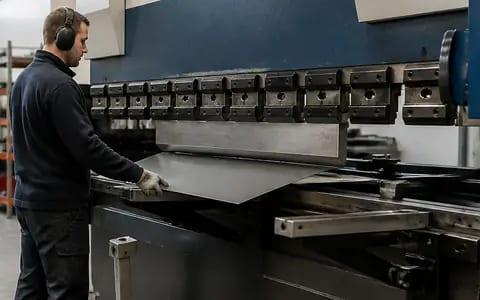
When setting up a job on a press brake, a number of factors can vary between the same material thickness and the same material type. This is primarily based on the V-opening of the die used to make the bend. A wider V-opening allows for a longer arm and hence less force is required to complete the bend, than a narrower V-opening which concentrates the force and requires more force to form the same bend. Typically, the opening of the V is set at around 8 times the material thickness, but if this is varied then the tonnage required also needs to be recalculated for the new setup.
Air Bending, Bottoming and Coining Aren’t the Same Load
Air bending, bottoming and coining all have different forces associated with them. Air bending is the least forceful of the three methods of bending and can offer some degree of flexibility in terms of the angle formed. Bottoming involves pushing the material fully into the die and typically requires several times the force of an air bend of similar angle. Coining involves forcing the material to the precise dimensions of the die and typically requires 3 times to 5 times the force of an air bend of similar angle. This must be taken into account when using a tonnage chart.
Build In a Safety Margin
Work with the natural variation in the mill supplied sheet thickness. Typical thicknesses for stock materials are allowed a tolerance of plus or minus 0.1mm and greater for lower cost items. Simultaneous bends across a stroke all get counted in the required tonnage. It’s sensible to allow 10% to 20% for these variables to ensure that adequate force is provided for the bend without wasting excessive capacity for a one-off.
Use a Chart Rather Than Guessing
In practice, calculating tonnage every time for every job is not practical. A proper tonnage chart is far more valuable than being able to recall figures from memory. For tonnage references built into control panels see the range of Bending Machines from Cotswold Machinery. A simple printed chart taped to a wall near a machine is also good practice for less frequently used materials.
If you check the tonnage setting required for unfamiliar jobs in a proper chart before use, it will take a few minutes to ensure that the correct material, thickness and opening size are used for the required bend and it will save a lot of material, a lot of damage to your tools and a lot of stress and extra wear on your machines.