

You wake up with a stiff neck, flip your pillow over, punch it into shape, and still can’t get comfortable. The problem is often not the pillow itself but its firmness level — and “firm” and “medium-firm” are not interchangeable. The difference comes down to how much the pillow compresses under your head, which in turn changes how your neck, shoulders, and spine align overnight. If you have been comparing options, the Pillow Showcase review of Sasttie pillows is a useful reference point because it shows how one brand’s firm and medium-firm models behave in real sleeping positions. Here is how to tell them apart and choose correctly.
Quick Answer
A firm pillow compresses very little and keeps its height under the weight of your head, making it better for side sleepers, larger body frames, and people who need strong neck support. A medium-firm pillow sinks in moderately, cradles the head, and suits back sleepers, combination sleepers, and average-weight sleepers who want support without pressure. Neither is universally better — the right choice depends on your sleeping position, body weight, and mattress firmness.
Key Takeaways
- Firmness describes how much a pillow compresses under load, not how “hard” the fabric or fill feels to the touch.
- Side sleepers generally need firm pillows to fill the gap between the neck and shoulder; back sleepers usually do better with medium-firm.
- Body weight changes everything — a pillow that feels medium-firm to a 130-pound sleeper may feel soft to someone at 220 pounds.
- Your mattress matters: a firm mattress pushes the shoulder up, which often calls for a slightly taller or firmer pillow.
- Firm pillows are not automatically “better support” — too firm can flatten the neck’s natural curve and cause as much pain as too soft.
What “Firm” and “Medium-Firm” Actually Mean
Pillow firmness is a measure of compression resistance — how far the pillow sinks when your head rests on it. It is not the same as surface feel. A pillow can feel plush to the hand and still be firm in practice if the fill is dense and springs back quickly. If you are revamping your entire sleep space, check out our guide on Create a cozy bedroom with soft textures and layered bedding.
In practical terms:
- Firm: compresses roughly 10–25% under a typical head’s weight. It stays tall and holds its shape through the night.
- Medium-firm: compresses roughly 25–50%. It gives noticeably under weight but still returns to shape when you lift your head.
- Soft: compresses more than 50% and tends to bottom out, meaning your head nearly reaches the mattress.
Those percentages are approximate ranges used across the industry rather than precise standards, because no universal pillow-firmness scale exists. Manufacturers label firmness differently, which is why two “firm” pillows from different brands can feel a full category apart.
How Sleeping Position Changes the Answer
Your sleeping position is the single biggest factor in choosing firmness. The goal is to keep your head, neck, and spine in a roughly straight line — not tilted up, not drooping down.
Side sleepers
Side sleeping creates a large gap between the head and the mattress because your shoulder holds you up. A firm pillow fills that gap and prevents the neck from sagging sideways. A medium-firm pillow can work for side sleepers with narrower shoulders, but many side sleepers find it collapses too much by morning.
Back sleepers
Back sleeping needs less height because the head sits closer to the mattress. A medium-firm pillow supports the neck’s natural curve without pushing the chin toward the chest. A firm pillow is often too tall here and can create a forward-head angle that leads to morning tension.
Stomach sleepers
Stomach sleepers need the least height of all — usually a soft or very low-profile pillow, or none at all. Neither firm nor medium-firm is ideal, because both lift the head too high and force the neck to twist.
Combination sleepers
If you shift between back and side during the night, medium-firm is usually the safer compromise. It has enough give to stay comfortable on your back and enough structure to support your neck when you roll onto your side.
Firm vs. Medium-Firm: Side-by-Side Comparison
| Factor | Firm Pillow | Medium-Firm Pillow |
|---|---|---|
| Compression under head weight | Minimal; stays tall | Moderate; sinks and recovers |
| Best sleeping position | Side | Back, combination |
| Body weight fit | Average to heavier frames | Lighter to average frames |
| Neck alignment effect | Keeps neck level with spine | Cradles neck, mild contour |
| Common downside | Can feel too high or rigid | Can bottom out for heavy side sleepers |
| Break-in period | Often longer | Usually short |
The table shows tendencies, not rules. A 110-pound side sleeper may be perfectly happy with medium-firm, while a 200-pound back sleeper may need firm simply because their head compresses the fill more.
The Body Weight Factor Most Guides Skip
Pillow firmness ratings assume an average adult. If you weigh significantly more or less than that average, the label tells you less than you think.
Heavier sleepers compress any pillow more, so a medium-firm pillow may behave like a soft one. Lighter sleepers compress less, so a firm pillow may feel like a brick. This is why two people in the same bed can have completely opposite reactions to the same pillow.
A practical rule: if you are a side sleeper and your head is sinking close to the mattress, go firmer. If you wake with a numb or tingling arm, the pillow may be too tall and firm — that pressure usually comes from the pillow pushing your shoulder into an awkward position.
How Your Mattress Interacts With Pillow Firmness
Pillows and mattresses work as a system, and this is where many buyers go wrong.
- Firm mattress: your shoulder stays higher, widening the head-to-mattress gap. You usually need a firmer or taller pillow.
- Soft, sinking mattress: your body settles lower, closing the gap. A medium-firm pillow often fits better.
- Adjustable base or elevated head: raising the head of the bed shifts pressure toward the shoulders, and some sleepers need a firmer pillow to compensate.
If you recently changed mattresses and your pillow suddenly feels wrong, the mattress — not the pillow — may be the real change.
Fill Material Affects Firmness More Than the Label Does
Two pillows labeled “firm” can perform very differently depending on what is inside.
- Shredded memory foam: firmness is adjustable by removing or adding fill. This is the most flexible option and great for people who are unsure.
- Solid memory foam: consistent and contouring, but firmness is fixed. It also tends to sleep warmer.
- Latex: naturally springy and durable; tends to feel firmer than foam at the same height.
- Buckwheat or hull fill: extremely firm and moldable, but noisy and heavy.
- Down or down alternative: rarely firm; compresses quickly and needs frequent fluffing.
If you want a firm feel that still contours, shredded foam or latex usually beats solid foam. If you want medium-firm with a soft surface, a foam core wrapped in fiber is a common design.
Signs You Chose the Wrong Firmness
Your body gives clear feedback within a week or two. Watch for these signals:
- Pillow too firm: morning neck stiffness, headaches at the base of the skull, chin pushed toward chest, or a pillow that never seems to “give.”
- Pillow too soft: waking with your head flat on the mattress, shoulder or arm numbness, needing to fold or double the pillow, or constant fluffing.
- Right firmness: you wake in roughly the same position you fell asleep in, with no neck tension and no urge to reposition the pillow during the night.
Give any new pillow at least a week before judging it, since foam and fiber fills need time to break in. If nothing improves after two weeks, the firmness category — not the brand — is probably the issue.
How to Test Firmness Before You Commit
- Lie on the pillow in your usual sleeping position for at least ten minutes in the store, or use the return window at home.
- Check the gap: with your head down, your neck should be level, not angled up or down.
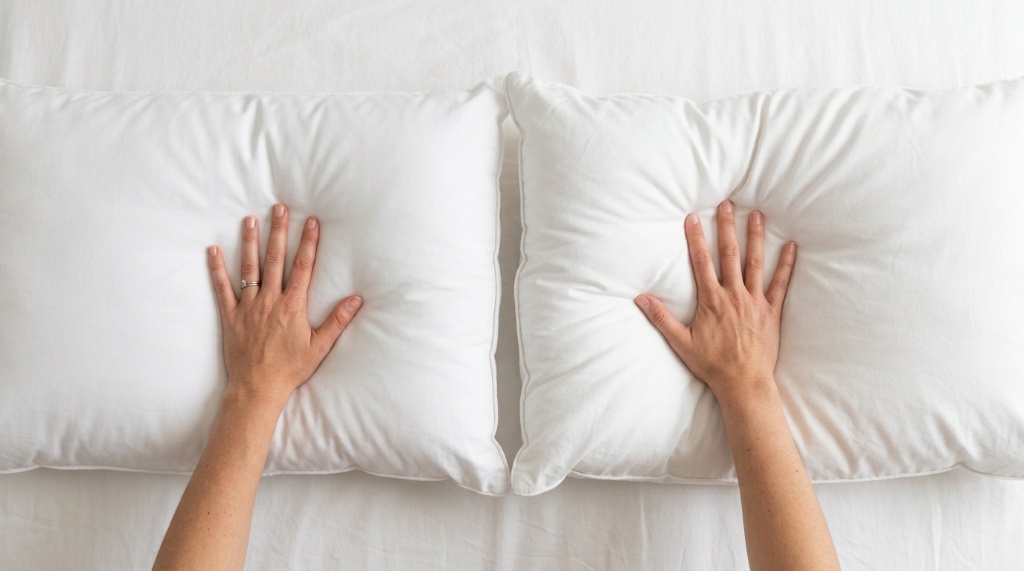
- Press with your palm — a firm pillow resists noticeably; a medium-firm one gives about a third of the way down.
- Ask about the return policy before buying. Firmness is personal, and even good pillows miss the mark for some sleepers.
- If you are between categories, choose adjustable fill so you can tune it rather than guessing.
Frequently Asked Questions
Is a firm pillow better for neck pain?
Only if your neck pain comes from insufficient support — usually in side sleepers. For back sleepers, a firm pillow often makes neck pain worse by lifting the head too high. The right firmness is the one that keeps your spine neutral in your sleeping position.
Can a medium-firm pillow work for side sleepers?
Yes, especially for lighter sleepers or those with narrower shoulders. If you are a heavier side sleeper or sleep on a firm mattress, medium-firm often compresses too much by morning and a firm pillow is the better fit.
Do firm pillows last longer?
Not necessarily. Longevity depends mainly on fill material and quality rather than firmness. Latex and high-density foam tend to hold their shape longest; down and low-density fiber flatten fastest. A firm pillow made from cheap fill can sag as quickly as a soft one.
How long does it take to adjust to a new pillow firmness?
Most sleepers adjust within one to two weeks. Foam and fiber fills also soften slightly during that period as they break in. If you still have neck or shoulder discomfort after two weeks, the firmness category is likely wrong for you.
Should both pillows on a bed be the same firmness?
No. Partners often differ in weight and sleeping position, so matching firmness is rarely necessary. Choosing individually is more comfortable, even if the pillows look mismatched.
Does pillow height matter as much as firmness?
They work together. Height determines how far your head is lifted; firmness determines how much that height holds under weight. A tall soft pillow and a short firm pillow can end up providing similar support, which is why testing in your sleeping position matters more than reading labels.
Conclusion
The difference between firm and medium-firm comes down to compression: firm pillows hold their height and suit side sleepers, heavier frames, and firm mattresses, while medium-firm pillows sink moderately and fit back sleepers, combination sleepers, and lighter frames. Rather than picking the firmer option by default, match the pillow to your sleeping position, body weight, and mattress, then give it a week or two to break in. If you are unsure, adjustable-fill pillows let you fine-tune firmness instead of gambling on a fixed label.